


New toll regulation from 1 July 2026
Dutch truck toll fully automated and transparent
Real-time insight into toll, CO₂ and actual cost per kilometer
Since 1 July 2026, a kilometre-based truck toll applies in the Netherlands to trucks with a maximum permissible weight above 3,500 kg. In addition to the distance-based toll, CO₂ emissions will play a decisive role in the tariff.
With the GPS-Buddy solution, paid toll amounts are made visible within trip reports. This provides immediate insight into driven kilometers and the associated costs. All within one platform.

What will change due to the truck toll?
On 1 July 2026, the Netherlands replaced the Eurovignette with a distance-based toll for trucks above 3,500 kg. The toll applies to all Dutch motorways and a number of national (N) roads.
The tariff is determined based on:
-
Permissible maximum mass
-
EURO emission class
-
CO₂ performance class
-
Number of kilometers driven
Cleaner vehicles pay less. Higher emissions mean higher costs per kilometer.

The impact on businesses
The truck toll has direct consequences for operational costs:
-
Variable costs increase
- Cost per trip changes
- CO₂ emissions gain financial impact
- Administrative processing becomes more complex
- Invoicing towards clients must be adjusted
Without real-time insight into driven kilometers and related toll charges, there is no clear overview of the actual impact per vehicle and per trip.
These partners trust our solutions


Truck toll integrated by GPS-Buddy and MSTS Tolls (Shell)
Een content hoofd tekst. Lorem ipsum dolor sit amet, consectetur adipis cin elit. Nunc purus libero, interdum sed blandit acp retium facilisis turpis. Donec dictum neque veloran tristique egestas nulla mollis dui lorem dolor.
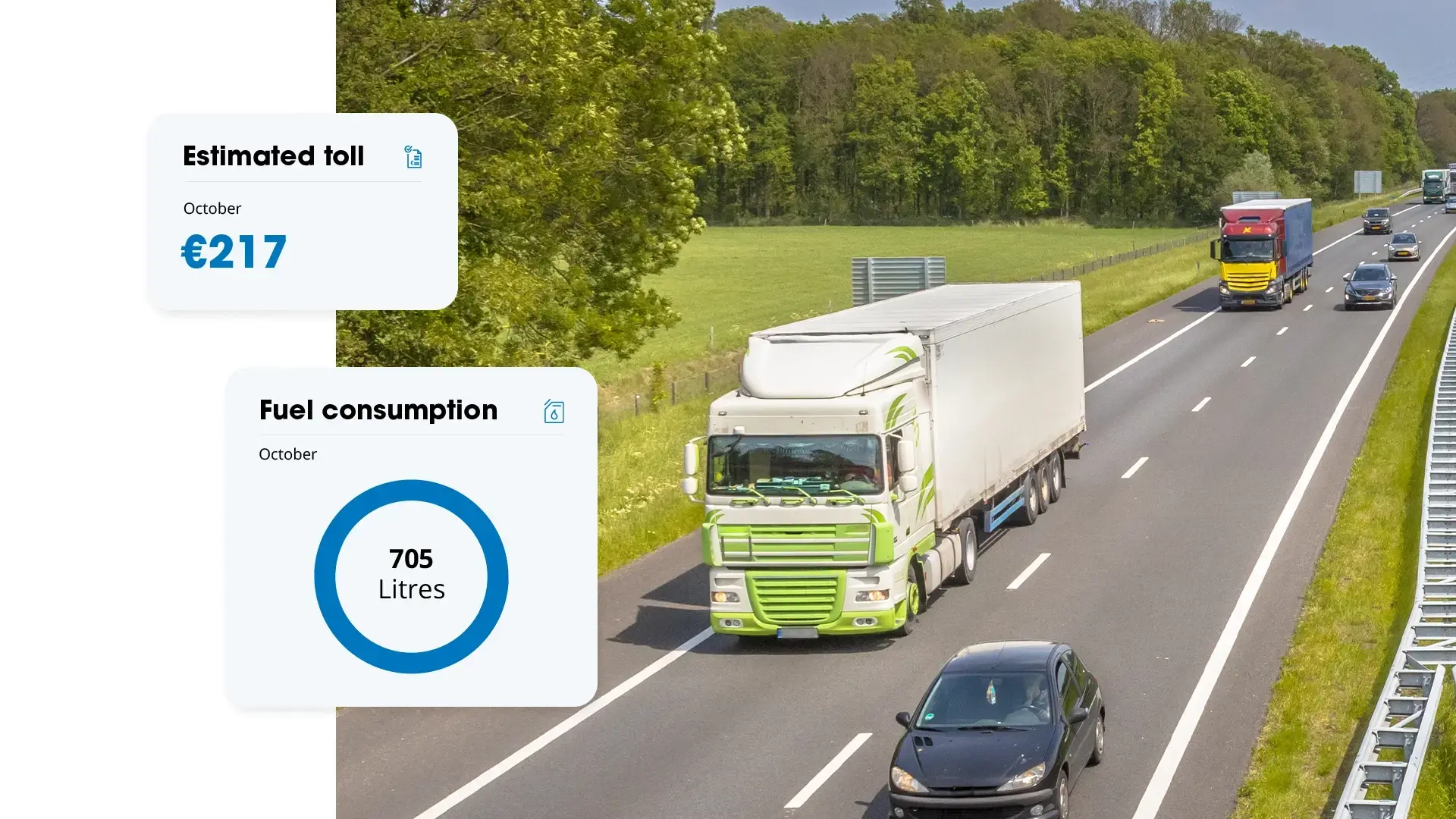
Instant insight into your toll costs
With the toll calculation in Flowter, you see almost in real time how much truck toll your vehicles are paying. Flowter calculates the toll based on the GPS location of your vehicles, with high accuracy and without waiting for the toll invoice. This way you know straight away which costs you can pass on to your customers, and your administration stays up to date. When the invoice arrives, you can simply compare it with the calculation as a check.
How it works step by step
Tab titel

1. Start with a short assessment
After the request, the situation is reviewed.
Tab titel

2. Set up toll registration
The toll registration is arranged through cooperation between GPS-Buddy and MSTS Tolls (Shell), ensuring the truck toll is processed correctly and the foundation is in place before the start date.
Tab titel

3. Activate the integration within GPS-Buddy
The paid toll amounts are linked to the corresponding trips within the GPS-Buddy platform. As a result, driven kilometers and toll charges become visible together in the reports.
Tab titel

4. Manage from one central overview
From that moment on, toll data, trip information and vehicle data are available within one platform. This enables easier analysis, reporting and internal management.

What does the truck toll solution deliver?
The solution ensures that truck toll does not become a separate cost stream but part of the existing fleet overview. Concretely, this provides:
-
Insight into paid toll per trip and per vehicle
-
Immediate overview of driven kilometers and associated toll charges
-
Transparent substantiation for recharging costs to clients
-
Fewer manual checks and less administrative fragmentation
-
Control over variable costs that move with deployment and vehicle type
-
One central overview combined with trip data, vehicle performance and idle time
-
Reliable implementation through cooperation with MSTS Tolls (Shell)

Arrange the truck toll in time
The new regulation is approaching quickly.
Prevent cost uncertainty and set up a future-proof solution in time.