

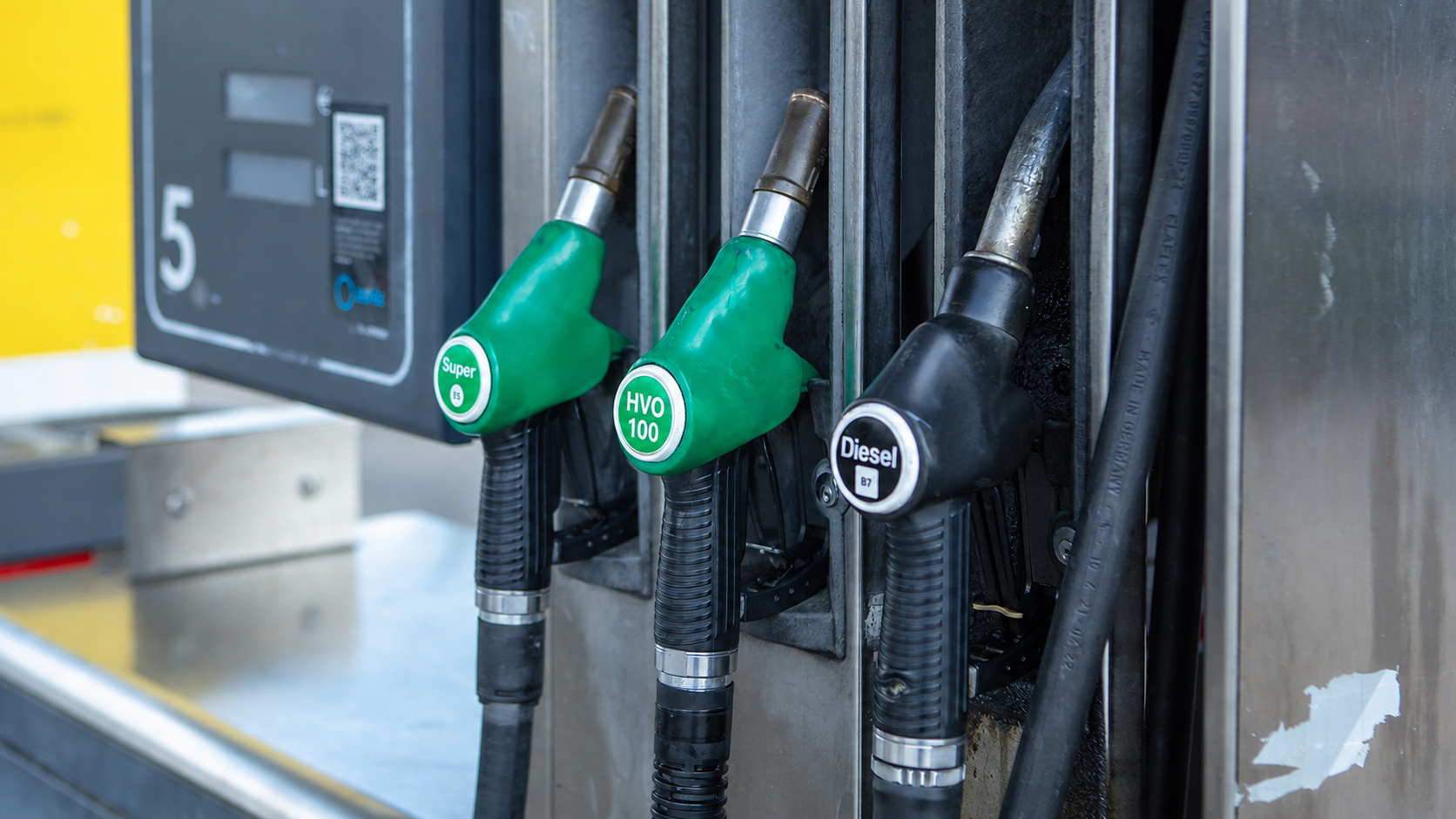
What is HVO-100, and what does it mean for your emissions figures?
You see it more and more often on construction sites: a tanker truck with "HVO-100" on the side. Contractors use it as an alternative to diesel in cranes, shovels and trucks. But what exactly is HVO-100, how does it compare to regular diesel, and what will you notice in your emissions figures if you switch? We explain it in this article.
What is HVO-100?
HVO stands for Hydrotreated Vegetable Oil. The fuel is made from waste fats, used frying oil, animal fats and vegetable residual streams. These raw materials are treated with hydrogen, a process called hydrogenation. This produces a clear, paraffin-rich fuel with properties close to those of fossil diesel. HVO-100 is the pure form: 100% HVO, with no fossil diesel blended in. A blended form is called HVO-20 or HVO-50, containing 20% or 50% HVO with the rest being fossil diesel.
What is the difference between HVO-100 and diesel?
Diesel and HVO-100 both have to meet a European quality standard. Such a standard is an agreement on what a fuel must comply with before it can be sold at the pump: its composition, properties and safety. This ensures every liter has the same quality. Diesel falls under standard EN 590. HVO-100 has its own standard, EN 15940. That separate standard exists because HVO-100 is composed differently from diesel and therefore falls outside the requirements of EN 590.
The difference lies in the composition. HVO-100 contains almost no sulfur and has a higher cetane number, which results in cleaner and more complete combustion. However, a liter of HVO-100 contains slightly less energy than a liter of diesel, which usually causes a small increase in consumption per liter.
In practice, you'll notice little of these differences. HVO-100 works in most existing diesel engines without any modifications to the engine or fuel system, and can be mixed with diesel in any ratio. Manufacturers approve it for many models from Euro 5 or Euro 6 onward. If in doubt, always check the engine manufacturer's approval.
Is HVO-100 the same as biodiesel or blue diesel?
These names are often used interchangeably, but they don't mean the same thing. Traditional biodiesel (sold at the pump as B7 or B100) is an older type of renewable fuel that can be more sensitive to cold, contamination and spoilage during storage, whereas HVO-100 doesn't have these drawbacks and behaves like regular diesel in the engine. "Blue diesel" isn't a fixed fuel but a trade name that varies by supplier: sometimes it contains HVO, sometimes another sustainable diesel blend. So the name itself says little; what matters is the product specification and the sustainability certificate, because for your CO2 reporting, only what you can demonstrably prove you filled up counts.
What does HVO-100 mean for construction, infrastructure and logistics?
For construction and infrastructure, HVO-100 is especially interesting for equipment that can't yet run on electricity: excavators, shovels, cranes and generators. In recent years, more and more construction and infrastructure companies have switched to HVO-100 for the portion of their equipment that runs on diesel. The CO2 savings achieved this way can count toward the CO2 Performance Ladder, provided the fuel is demonstrably produced sustainably.
In transport and logistics, the threshold to switch is often lower, because trucks change location less frequently and can more easily refuel at a fixed tank location. For construction and infrastructure, the project location plays a bigger role: not every project has a filling station with HVO-100 nearby, and equipment is often refueled on-site from a tanker truck.
What does HVO-100 do to your emissions figures?
Physically, burning a liter of HVO-100 releases roughly the same amount of CO2 from the engine as diesel does, around 2.446 kilograms. The difference lies in how that CO2 is counted. Because HVO-100 is made from renewable raw materials such as waste and vegetable fats, the CO2 released during combustion is counted as biogenic. In official CO2 reporting, that combustion therefore counts as virtually zero.
What remains is the CO2 cost of producing and transporting the fuel. In the official emission factors, a liter of HVO-100 therefore comes out at around 0.468 kg CO2, compared to around 3.46 kg for fossil diesel. That's a saving of roughly 86%.
For your reporting, the number of liters of HVO-100 filled is the starting point. To be allowed to count the saving toward, for example, the CO2 Performance Ladder or your CSRD reporting, you must be able to demonstrate that the HVO-100 was produced sustainably. You do this with the supplier's certificate, often called a Proof of Sustainability. Without that documentation, a tank of HVO-100 doesn't automatically count as a CO2 saving.
This article describes a situation in the Netherlands. The CO2 figures mentioned are based on the official CO2 emission factors list (co2emissiefactoren.nl), managed by Rijkswaterstaat and Stichting Stimular. Please consult the official sources for the most current information. Situations may change. No rights can be derived from this article.