

What is RFID and how does it work?
RFID is in the pass you use to enter an office, in the label on a new jumper and in the chip under a dog’s skin. It is the same technology every time: a tag with a chip and an antenna that can be identified using radio waves. In construction, infrastructure and transport, companies use RFID to keep track of where equipment without its own power supply is, from a laser level to a container.
Read on to find out what an RFID tag is, how it works and why the difference between passive and active matters so much.

16 November 2026
Een content subheading
5 min read
What is RFID?
RFID stands for Radio Frequency Identification: recognising objects using radio waves. An RFID system consists of a tag on the object, a reader that detects the tag, and software that records which tag was seen where and when.
Every tag has a unique code. That way the system knows exactly which object it sees, even when ten identical plate compactors are standing side by side. NFC, which you use to pay with your phone, is a form of RFID that works at a distance of a few centimetres. Equipment on a construction site needs a much larger range.
How does an RFID tag work?
An RFID tag communicates with a reader using radio waves. When the tag comes within range, the reader recognises its code and passes it on to the software.
The key difference from a barcode or QR code: the tag does not need to be in sight. A reader also detects it inside a toolbox, behind a stack of formwork or under a tarpaulin. And it sees several tags at once, so nobody has to scan them one by one.
How far that works, and whether you need to do anything yourself, depends on the type of tag.
What is the difference between a passive and an active RFID tag?
An active RFID tag has its own battery, a passive tag does not. That one difference determines how far a tag reaches, how you read it and what you use it for.
A passive tag gets its energy from the reader’s signal. Only when a reader comes close does the tag pass on its code. The range runs from a few centimetres to around 10 metres, depending on the frequency. Passive tags are small and cheap, which is why they are used in clothing labels and access passes. To read them, you scan them with a handheld reader or pass them through a gate.
An active tag sends out a signal itself. As a result, it reaches much further than a passive tag, and a reader detects it without anyone having to do anything. An active tag also has room for sensors, for example for movement or temperature.
Does an RFID tag have GPS?
An RFID tag has no GPS module and no SIM card. The location comes from the reader: it knows where it is itself, and sees which tags are nearby.
If the reader is fixed, for example at the gate of a warehouse, you know that a tag has passed that gate. If the reader is in a vehicle with GPS, it travels along and sees every tag nearby on the way. Every time such a reader detects a tag, the location of that tag is updated.
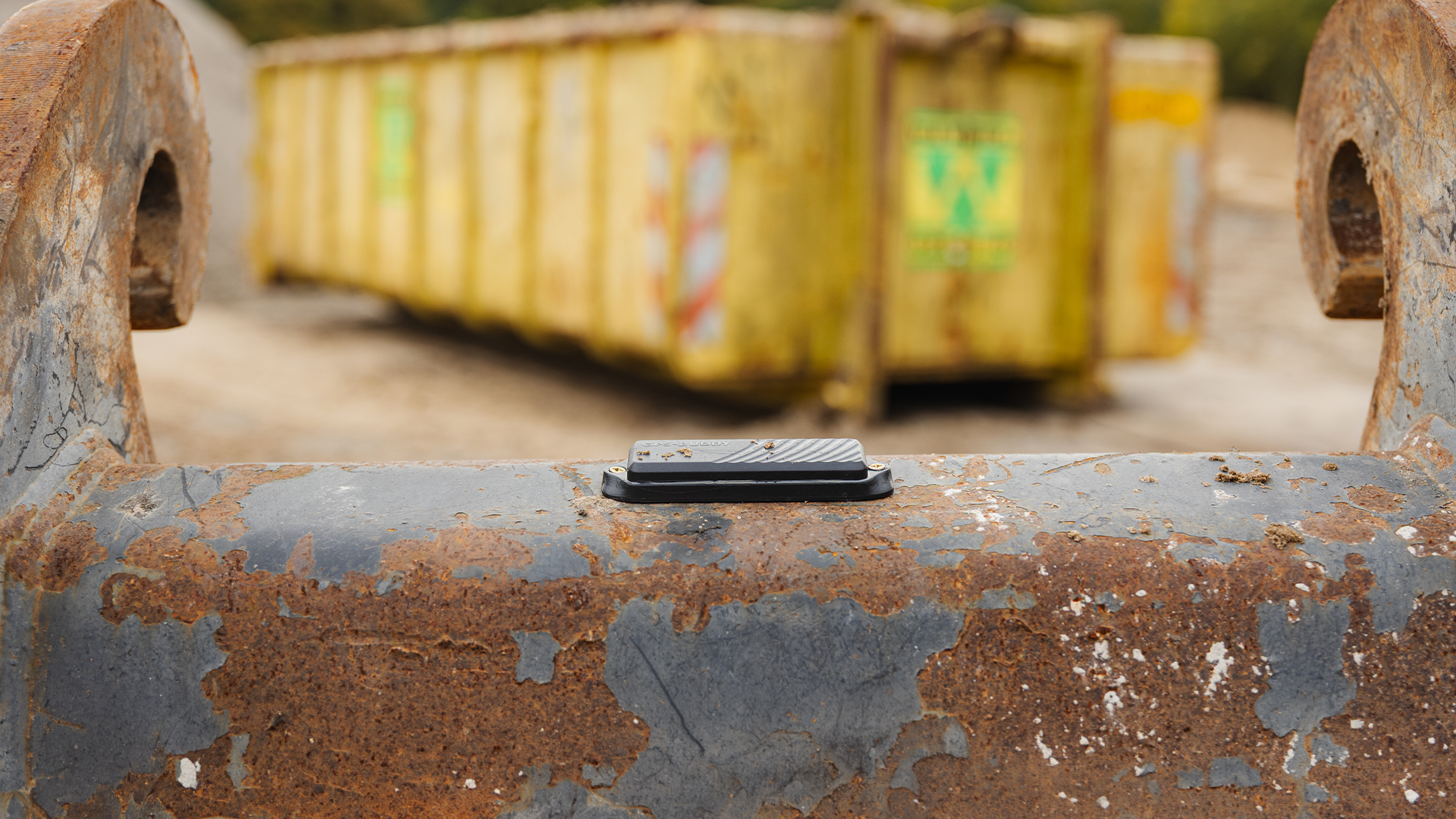
That is how asset tracking works at GPS-Buddy. Every XT-4 in a vehicle or machine is also a gateway: a reader that picks up tags nearby and sends their position to Flowter. When a tag is stationary, you see the place where a gateway last detected it. If there is briefly no gateway in range, the tag stores its data until the next one passes by.
In Amsterdam, City Barging transports building materials and waste over the water, with 40 transport barges that have no power supply of their own. Each barge has a tag, and the push boats have an XT-4. When a push boat passes by, the barge is back on the map. “We used to literally sail around in circles looking for the lost barge,” says maritime manager Willem Post.
How far does an active tag reach, and how long does it last?
The range depends on the frequency, the transmission power and the surroundings. A well-known objection to RFID is that metal and water interfere with the signal: metal reflects radio waves and water absorbs them. Passive UHF tags in particular suffer from this, because they work only with the small amount of energy the reader sends. An active tag transmits using its own battery, and therefore keeps more of its range.
The active tags from GPS-Buddy transmit on a frequency below 1 GHz, which passes through steel, concrete and glass. The signal reaches more than 10 times further than that of industrial Bluetooth. With SmartRange, the Pro Tag adjusts its transmission power itself. If it is far away or behind concrete, it transmits more strongly. When it comes closer, it scales back and the location becomes more precise.
How long an active tag lasts depends on the battery and on how economically the tag uses it. Every tag contains a motion sensor: when the equipment starts moving again after standing still, the tag transmits again. This way the Asset Tag lasts up to 8 years on a single battery.
What do you use RFID for in construction, infrastructure and transport?
Wherever equipment moves without its own power supply.
Tracking tools and small equipment
Laser levels, plate compactors, generators and containers have no battery you can connect a tracker to. With a tag, you can still see where they are. If a laser level is in the van, it travels along visibly. If it is left behind on a project, you see where it was last seen. For small tools that are hard to tag, there is a smaller tag.
At Beentjes GWW, laser levels kept going missing, and new ones were ordered every year. Since the laser levels were tagged, not a single one has been lost.
Pairing truck and trailer automatically
The trailer has a tag, the truck an XT-4. When they drive together, Flowter pairs them automatically. That way you know which truck drove which trip with which trailer. When the trailer is uncoupled for loading or parking, you see where it was last seen. Transportbedrijf Peter van Setten works this way with its trucks and trailers.
RFID in asset management
A tag shows more than the location. The motion sensor also measures operating hours: a plate compactor or generator vibrates as long as it runs. That way you plan maintenance for equipment without a CAN bus on actual use, and see which equipment is consistently underused. With a geofence around a project, you get an alert when a generator leaves outside working hours.
What is the difference between RFID, GPS, Bluetooth and LoRa?
With all of these technologies you can find equipment again, but each determines the location in a different way.
Passive RFID. A reader at a gate or in your hand sees the tag at a distance of a few centimetres to around 10 metres. The tag does not need a battery.
Active RFID. A gateway nearby, fixed or in a vehicle, detects the tag at tens to hundreds of metres. The tag has its own battery that lasts for years.
Bluetooth. Also a tag with its own battery and a receiver nearby, but on a higher frequency of 2.4 GHz and usually over tens of metres.
LoRa. A network for small messages over distances of kilometres, using little energy. It does require coverage. For a precise location, a LoRa tracker usually has GPS on board as well. Without GPS, the network estimates the position, which can then be off by hundreds of metres to kilometres.
GPS tracker. Determines its own position via satellites and sends it on via the mobile network. Under normal conditions, it is accurate to within 5 to 10 metres. This does require power, and indoors or between tall obstacles the signal gets weaker.
The technologies are not mutually exclusive. At GPS-Buddy, GPS and active RFID work together: the XT-4 uses GPS to determine where it is, and passes that location on for every tag it detects nearby.
Which one do you choose?
That depends on where your equipment is and how it moves.
- Passive RFID suits places where you already scan, such as a warehouse or an issue counter.
- Active RFID with gateways suits equipment that moves back and forth between projects. You need no SIM card or power per asset, and the battery lasts for years.
- A GPS tracker with its own 4G suits equipment that stays in one place for a long time where no gateway passes by, such as a remote site. The AT-4 from GPS-Buddy reports its location there itself.
For most equipment, an active tag is the first choice. It lasts longer and costs less per asset than an AT-4. The GPS tracker fills the gaps where the gateway network does not reach. Read more about the different ways to track equipment in What is asset tracking?
What do you gain when that data comes together?
A tag tells you where a laser level is. Alongside the data from your vehicles and machines, it tells you more: which generator has been standing idle for a week while another project is renting one, or which equipment keeps travelling with the wrong crew. In Flowter, that data comes together. A location becomes insight, and insight becomes a decision. We call that Asset Intelligence.
Curious how this works for your own equipment?
Melanie van den Berg
Online marketeer
Making complex topics easy to understand, and getting my teeth into them first: that's what energises me. In my previous marketing roles, I really enjoyed working with companies in construction, infrastructure and transport. As an online marketer at GPS-Buddy, I like to write about developments in these sectors. I bring the same energy to writing about our own solutions: how they work, and what they deliver in practice for the people who use them. For my articles, I draw on the knowledge of my colleagues and dig into what's happening in the field myself, so that every piece is accurate and complete.